We are excited to announce our $2M seed round led by Joa Capital.
Read Now


11,937 conversations across X, Instagram, and TikTok analyzed, covering 30+ tracked entities: 16 national teams, 11 brands, and three host countries.
11,937 conversations across three platforms in the pre-tournament window. Every figure is drawn from real public posts.
DeepDive monitored conversations across X, Instagram, and TikTok in the 49-day pre-tournament window from March 31 to May 18, 2026. After filtering and de-duplication, 11,937 unique conversations remained. X is the volume engine. Instagram brings the visual culture, which is why it skews so much more positive. TikTok concentrates on short repeatable formats and runs much more neutral than X.
| Platform | Conversations | Share | Positive | Neutral | Negative |
|---|---|---|---|---|---|
| X (Twitter) | 8,140 | 68.2% | 39.0% | 34.1% | 26.9% |
| 2,287 | 19.2% | 66.4% | 31.1% | 2.5% | |
| TikTok | 1,510 | 12.6% | 35.8% | 50.5% | 13.7% |
| Combined | 11,937 | 100% | 43.8% | 35.6% | 20.5% |
For a growing share of the World Cup audience, the social feed isn't a side channel anymore. It's where the tournament actually happens.

FIFA itself has formalized the shift. TikTok became FIFA's first-ever Preferred Platform for the 2026 tournament, with a dedicated WC2026 hub, a creator program with behind-the-scenes access, and live-streaming rights for media partners. The 2026 tournament is being staged for the social feed as much as it is for the broadcast.
So, broadcast is no longer the centre of gravity. Global linear TV ad spend has dropped 27.5% over the past decade and now accounts for just 12.4% of total ad spend, down from 41.3% in 2013. Streaming overtook linear total TV usage for the first time in 2025. Among Gen Z fans, only 40% still watch live sports on cable, and 59% prefer highlights even when they can watch the full match. Brand spend is following: Unilever shifted 50% of its marketing investment to social and influencers in 2025, up from 30% the year before.
A 43.8% positive baseline on top of a corpus where the things people love and the things they dread sit very close to one another.
Five threads carry most of what's worth knowing from the corpus before the tournament starts.
The halftime show and the Messi farewell are the two warmest threads in the dataset. Ticket prices and Trump quotes are the two coldest.
Brazil has the volume. Argentina has the room. Italy and the US are the negative outliers, for opposite reasons.
Brazil's 507 conversations split 50% positive, 13% negative. Volume anchors to Vinicius Jr highlights, Neymar comeback content, and steady kit-leak speculation. Argentina sits 134 conversations behind on volume but posts a 58% positive, 6% negative split, the cleanest skew of any top-tier nation. Italy is the negative anchor at 40% negative across 131 conversations, carrying qualification-failure mourning. The USMNT runs negative on team-only chatter too, but for entirely different reasons covered below.
Three teams cleared the highest positive shares in the corpus at meaningful volume. Each has a clear reason behind the warmth.
Two teams sit at the negative end of the team-only table. Italy is the clear-cut case; the USMNT is a more moderate one driven by injury and squad-selection drama.
Brief, but worth flagging.
Argentina and Germany kits drew the cleanest positive reception. Mexico's drew an unexpected backlash, anchored by one TikTok complaining about commercial saturation that pulled 2.3M engagement on its own. The Croatia leak below, showing Adidas replacing Nike as the federation's kit supplier from 2026 onward, was the most-shared kit news item on Instagram. Nike returned no real qualifying signal across the dataset, the most notable absence in the brand section.
Adidas leads officials. Lego leads engagement as a creative collaborator. Aramco is the only sponsor in the dataset fans actively turned on.
Adidas dominates the official sponsor pool with 439 conversations and a 47% positive, 14% negative split. Coca-Cola is distant second at 113 with a 40%/19% split, mostly carried by broader-FIFA critique threads rather than activation chatter. Hyundai, Lenovo, and Qatar Airways all clear the inclusion threshold but post small samples that don't move at the volumes the bigger sponsors do.
Three brands pulled real audience warmth across the dataset.
Four patterns drove almost all of the breakout brand engagement. Ranked by total engagement.
Single-player viral clips and skill compilations. The largest engagement pool in the brand-relevant data, by a clear margin. Examples: Messi camera-lens TikTok, Ronaldo kindness moment, Yamal skills edits.
CGI or short-film creative that puts rival stars or cross-genre celebrities in one frame. Delivers the fantasy crossover the actual tournament physically cannot. Examples: Lego CGI ad, Adidas Backyard Legends.
The most populous content category in the brand pool. Long engagement tail on Instagram, well past the launch moment. Examples: Croatia Adidas kit leak, Panini sticker albums, Mexico kit backlash TikTok.
Language- and region-specific creator activations, particularly Latin American Spanish-speaking accounts. Some of the cleanest sentiment in the dataset shows up here. Examples: Lay's #LaysFWC26 series, Panini Mexico activations.
Two sponsors carry real negative signal. Both have small samples, but in both cases the criticism is consistent.
Three archetypes carry most of the tournament's brand-relevant audience. Each one rewards a different creative bet.
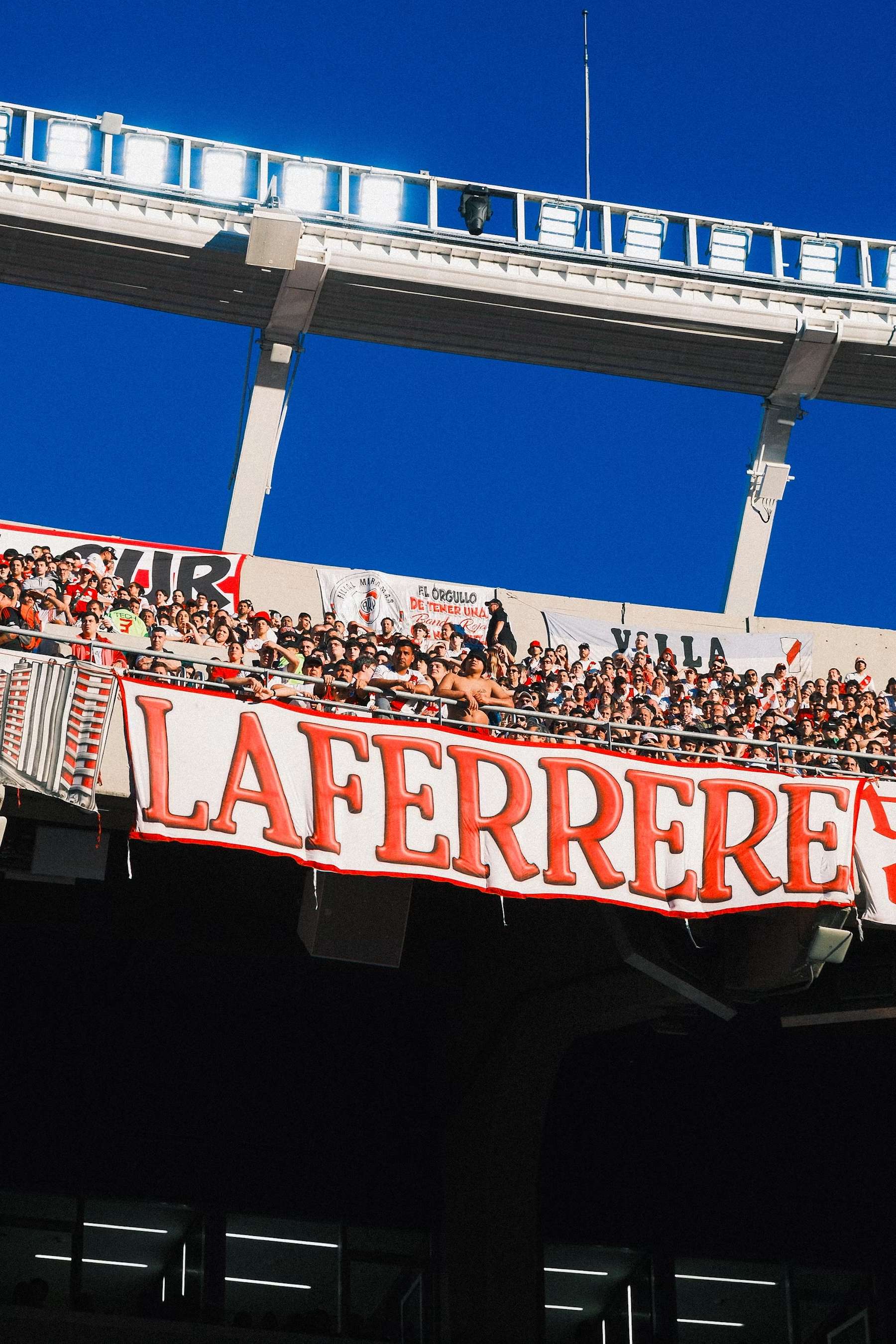
Track ticket sales, resale prices, scam warnings, transit costs, visa-bond news. The largest archetype in the dataset by far, almost entirely on X, and the most negative audience by sentiment share.
Kit launches, leaks, sticker books, jersey unboxings. The most populous fan in the corpus, concentrated on Instagram, with a long engagement tail well after the launch moment.
Halftime announcements, celebrity casting, music collabs. An audience that wouldn't be in the football conversation without the crossover moment that pulled them in.
Sentiment looks very different across the three host countries. American chatter is dominated by ticket prices and transit complaints around MetLife. Mexico's runs overwhelmingly positive, anchored to fan art and the opener at Estadio Azteca. Canada is the quietest of the three but the second-most positive, focused on fan-fest planning in Toronto and Vancouver.
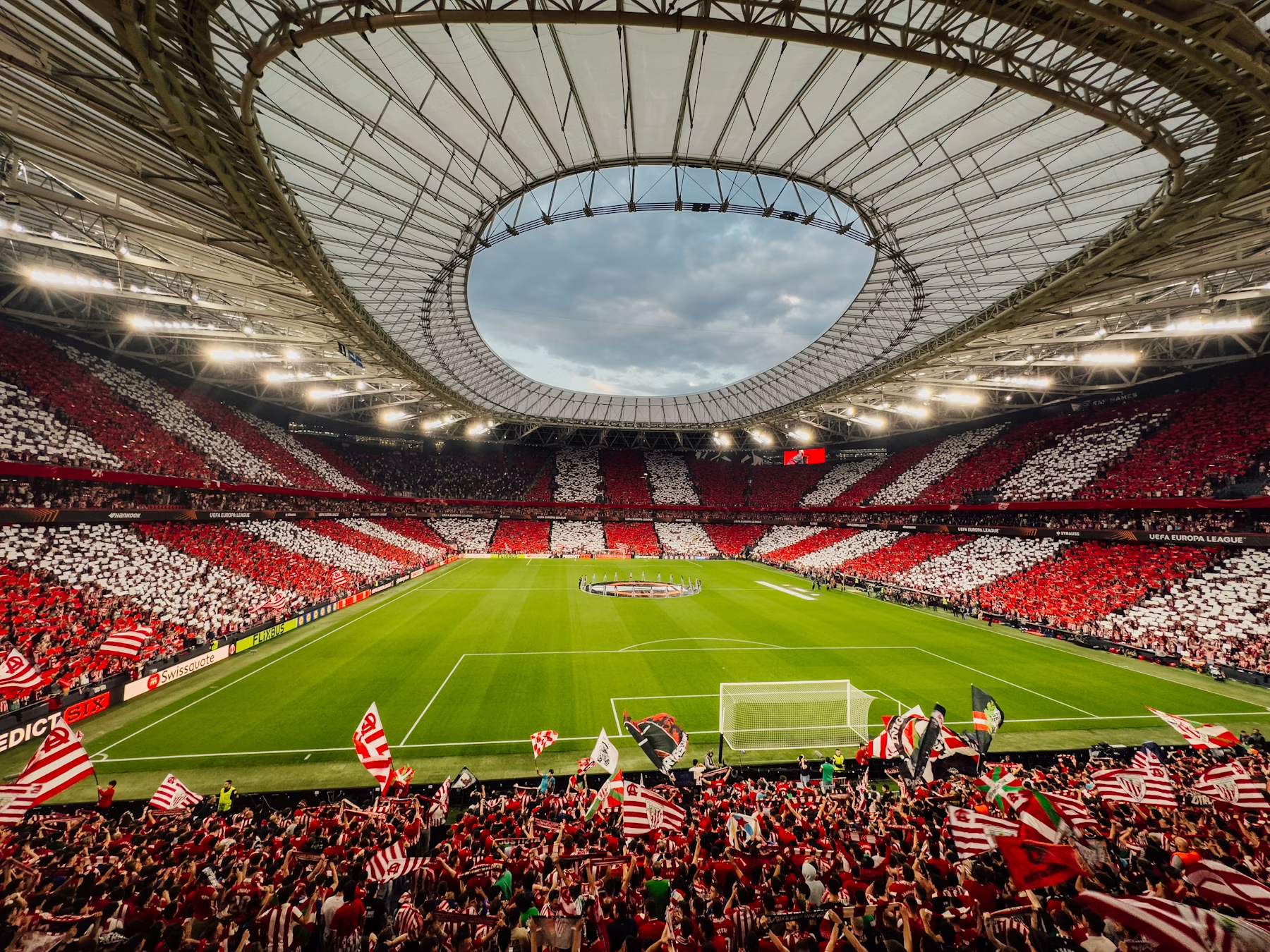
| Venue | Host | Mentions | Dominant thread |
|---|---|---|---|
| MetLife Stadium | USA · NJ | 132 | Ticket resale, NJ Transit surcharge |
| New Jersey (broad) | USA · NJ | 131 | Transit and access frustration |
| Miami / Hard Rock | USA · FL | 90 | Argentina and Latin American buzz |
| New York (broad) | USA · NY | 89 | Mixed fan-fest and ticket |
| Toronto / BMO Field | Canada · ON | 53 | CanMNT preview and fan-fest |
| Seattle / Lumen Field | USA · WA | 46 | Watch-party planning |
| Mexico City / Azteca | Mexico | 42 | June 11 opener anticipation |
| Vancouver / BC Place | Canada · BC | 31 | CanMNT and travel logistics |
2,128 cleaned posts mention tickets. Half are negative. Pricing alone runs 63% negative. The chapter where the report's gentle baseline disappears.
Two specific lines did most of the work in the ticket conversation. Gianni Infantino's defense of "US market-aligned" pricing, where he argued FIFA was obliged to use the dynamic-pricing flexibility US law allows. And Donald Trump's quote to the New York Post: "I wouldn't pay it either, to be honest." Both ran multiple news cycles, with Trump's quote pulling 370 conversations on its own and running 64% negative.
Trump rips $1,000 World Cup ticket prices, tells The Post: 'I wouldn't pay it either, to be honest'
Andrew Giuliani defends $1,000-plus World Cup ticket prices after Trump says 'I wouldn't pay it'
Resale chatter holds at 170 posts, 51% negative, with $60 group-stage tickets reselling for $2,300 as the most-cited number. Scam chatter is smaller (78 posts) but the most negative pocket in the entire report at 76%. Homeland Security Investigations issued a public warning about World Cup ticket scams in early May, and English-language fan groups began circulating fake-broker QR-code screenshots.
The travel-visa story is the rare positive note. 16 posts mention US visa logistics in a ticket context, half of them positive, anchored to the Trump administration's May 17 move waiving the $15,000 visa bond for World Cup ticket holders from 50 specific countries. Narrow news, but real, and it cuts against the rest of this chapter's tone.
Three broad plays for any brand thinking about the tournament. None of them require a sponsorship slot.
.jpg)