How we built this report
We built this report using DeepDive, analyzing 117,180 real public conversations from X (Twitter) and TikTok between April 10 and April 22, 2026. Every data point is drawn from what people actually said publicly, with no surveys or estimated figures.
The full collection parameters are below.
This report is part of DeepDive's Pro Bono Intelligence Series, periodic public releases that demonstrate the conversation intelligence available to brands, agencies, festivals, and operators on the DeepDive platform. The full dataset and real-time monitoring dashboard are available to DeepDive subscribers.
Coachella 2026 drew more public conversation than the 2025 edition
Across both weekends, the festival generated more public-social conversation than the 2025 edition tracked in the same window. Of 117,180 posts, 48.4% are positive and 17.7% negative. The bigger story sits beneath the macro number, in which performers, hashtags and activations broke out from the noise.
Summary of public reactions to the festival
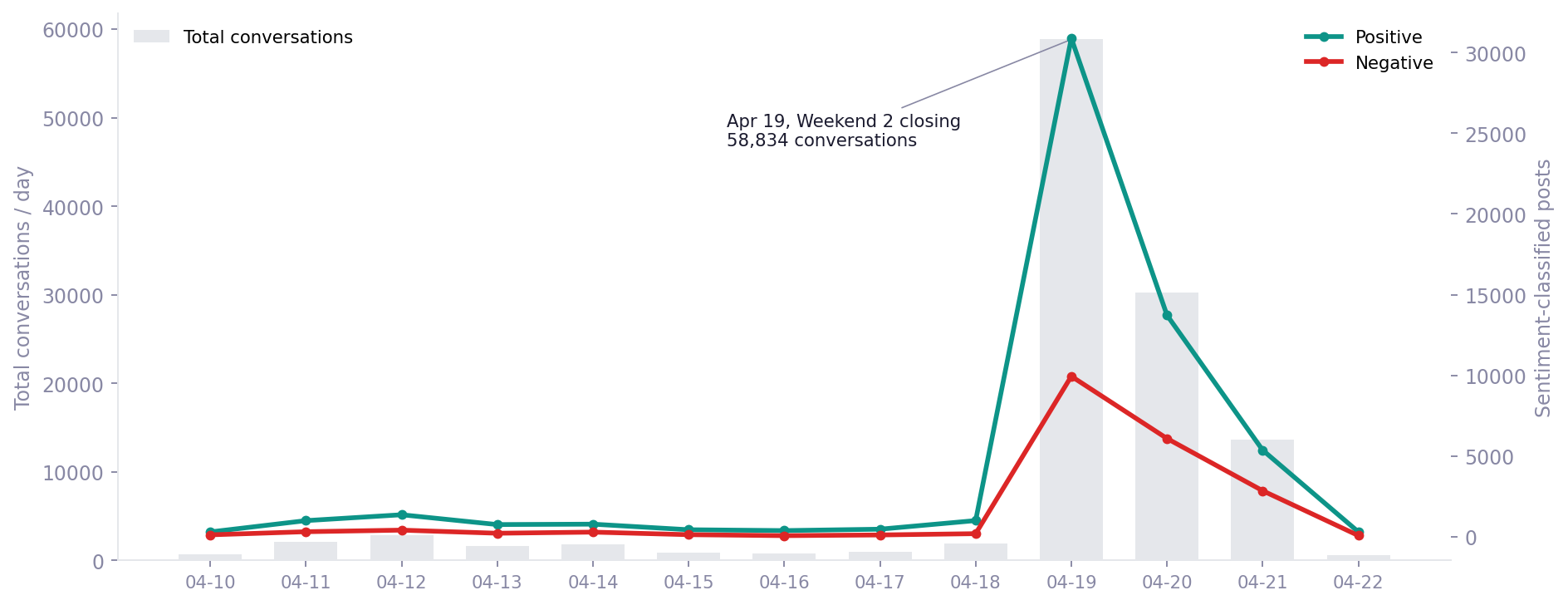
DeepDive traced a heavily concentrated conversation arc. Weekend 1 (Apr 10 to 12) and the mid-week stretch carried a moderate baseline. The festival's social gravity then shifted decisively to Weekend 2's closing Sunday (Apr 19), which generated 58,834 conversations in a single day. The post-festival reflection window (Apr 20 to 21) added a long tail of replays and recaps.
Daily conversation volume & negative sentiment, Apr 10 to Apr 22
What people liked most
Beneath the macro 48.4% positive share, four micro-narratives drive almost all of the positive sentiment across the dataset:
Headliner surprise drops
Madonna walking on stage during Sabrina Carpenter's "Like a Prayer", Billie Eilish joining Bieber for "One Less Lonely Girl", and the Bieber headline itself each generated multi-million-engagement clusters. Audiences write in the language of disbelief: "I AM DREAMINGGG", "NO WAY SABRINA", "I was there, and I feel 13 again."
Cross-cultural music moments
BINI's "Pantropiko" and Karol G's bilingual set drove some of the warmest sentiment in the dataset. "PANTROPIKO WILL ALWAYS BE THAT SONG" and "LATINA FOREVA" are among the highest-engagement non-English captions of the festival.
Outfit & aesthetic
#coachellaoutfit, #sabrinawood, and a long tail of fan-named ____chella tags signal that audiences are treating the festival as a fashion event as much as a music one.
Livestream-first viewing
#coachellalivestream-tagged posts averaged a sentiment score of 61.0, a +5.3 lift over the broader festival. The dominant emotion in livestream chatter is communal reaction, not FOMO.
Sabrina Carpenter brings out Madonna during Weekend 2 of Coachella.
— @PopCrave (@PopCrave) April 18, 2026
What people disliked most
Of 20,770 negative-classified posts (17.7% of the dataset), four micro-narratives drive most of the dislike. Three are concentrated controversy clusters; the fourth is a structural complaint about how the festival itself is changing.
Politically-charged on-stage imagery
The Strokes' Weekend 2 closing montage of CIA-deposed leaders and Iran/Gaza war footage drove 7% of all negative posts, the largest single negative cluster. Detailed analysis in the Special case #1 below.
The Madonna wardrobe controversy
After Madonna's surprise duet on Sabrina Carpenter's "Like a Prayer", her vintage jacket, corset and dress went missing from the Coachella stage. The public reward post drove a sustained 3.5% of negative posts into the post-festival window.
"Coachella isn't what it used to be"
A recurring strand (~2.3% of negative posts) frames the festival itself as smaller, thinner-crowded, and less culturally central than past editions. A festival-fatigue narrative no single artist or brand controls.
Merch pricing & scarcity backlash
Skylrk's record $15M sales weekend produced a parallel negative cluster (~1.5%) framing the merch as too expensive, queues as exclusionary, and Weekend 2 restocks as opaque. Scarcity sells volume, but it generates negative sentiment from the buyers it locks out.
Artists that won the stage
Volume tells you which artist owned the conversation. Sentiment tells you whose conversation you'd actually want to be inside. Engagement shows which performances pulled the audience in. Plotting all three together makes the real winners easy to see.
Top 5 performers, volume rank vs sentiment rank

| Rank | Performer | Mentions | Pos % | Neg % | Sentiment Index | Engagement |
|---|---|---|---|---|---|---|
| #1 | Justin Bieber | 25,957 | 51% | 16% | 57.5 | 995.7M |
| #2 | BINI | 18,218 | 82% | 5% | 67.9 | 30.2M |
| #3 | Sabrina Carpenter | 5,966 | 47% | 15% | 56.6 | 148.5M |
| #4 | Taemin | 5,840 | 49% | 7% | 59.4 | 8.8M |
| #5 | Karol G | 4,641 | 47% | 11% | 57.3 | 38.9M |
| #6 | BIGBANG | 3,739 | 51% | 14% | 57.6 | 28.0M |
| #7 | The Strokes | 3,214 | 35% | 28% | 49.5 | 23.2M |
| #8 | Madonna | 3,115 | 38% | 22% | 52.1 | 31.8M |
| #9 | Billie Eilish | 3,048 | 51% | 14% | 56.9 | 117.0M |
| #10 | PinkPantheress | 2,287 | 52% | 16% | 57.3 | 43.2M |
| #11 | Olivia Rodrigo | 1,689 | 42% | 19% | 53.8 | 31.2M |
| #12 | Addison Rae | 1,083 | 40% | 16% | 53.5 | 22.1M |
| #13 | SZA | 951 | 42% | 18% | 54.1 | 17.7M |
| #14 | KATSEYE | 922 | 39% | 23% | 51.7 | 64.4M |
| #15 | Young Thug | 707 | 24% | 35% | 44.6 | 28.6M |
| #16 | Geese | 251 | 39% | 15% | 53.3 | 1.8M |
| #17 | Devo | 130 | 45% | 10% | 53.0 | 1.6M |
Two headlines that made an outsized cultural impact
Two performances broke through as the festival's defining cultural moments, and the clearest evidence is that audiences spontaneously coined branded festival-territories around them. Both #bieberchella and #sabrinawood emerged from fans on the day and were used by tens of thousands of accounts within hours, an unusual signal of impact.
#bieberchella · Justin Bieber
The most-used non-festival hashtag of the dataset. Fans treated the headline set as a stand-alone cultural event, captioning it in monarchic and religious-event terms.
#sabrinawood · Sabrina Carpenter
A fan-coined rebrand of the festival into Carpenter's own celebrity district, driven by her surprise Madonna duet and her Dior wardrobe moment.
Commonalties among the top performers
Looking at the most-engaged-with quotes inside each top performer's cluster, three resonance patterns repeat across the dataset.
Surprise & lineage
Bieber, Carpenter and Madonna all generated their highest-engagement posts not from their headliner moments but from uninvited cameos and intergenerational duets. "Madonna made a surprise appearance during Sabrina Carpenter's set" alone drove 1.95M engagements.
Multi-cultural identity
BINI (Tagalog), Karol G (Spanish), Taemin (Korean), BIGBANG (Korean) and KATSEYE (multi-lingual) each drew deep, native-language fan communities into the conversation. Korean and Japanese fan tags (#태민, #テミン, #泰民) are some of the most engaged non-English tags inside the dataset.
Personalised fan branding
The high-sentiment performers are the ones whose audiences renamed the festival around them, with #bieberchella, #sabrinawood, #binichella, #taemchella, #karolchella, and #bangchella all emerging from fan accounts. Where there's a fan-coined tag, there's a halo lift of +3 to +12 sentiment points.
Performers that under-indexed on sentiment
Two performers landed below the festival sentiment baseline despite drawing real volume:
- Young Thug, 44.6 sentiment, 35% negative. The most negative-share performer of the festival, with the cluster dominated by post-RICO trial backlash and concerns about lyrical content rather than the Coachella performance itself.
- KATSEYE, 51.7 sentiment, 23% negative. Mixed reception driven by debate over the group's relationship-status visibility and choreography critique. Notably, this is a sentiment problem despite very high engagement (64.4M).
Special case #1: The cost of being political for The Strokes
The Strokes, a rock band from New York, had one of the more analytically interesting clusters in the dataset. The band closed Weekend 2 with a sequence of politically-charged on-stage imagery, including images of leaders the CIA helped depose, the war in Iran and Gaza, and a slide of the last university destroyed in Gaza. This single creative decision both produced the band's highest-engagement post in the dataset and almost all of their negative sentiment share.
the strokes highlighted the CIAs involvement in killing political leaders and overthrowing govts, showed the last university of Gaza being destroyed and showcased how racism and violence is ingrained in American history…they spoke up more with a screen than anyone at coachella..
— @livelyoongi (@livelyoongi) April 18, 2026
The cluster splits into three audience reactions: moral approval ("they spoke up more with a screen than anyone at Coachella"), music-first frustration at being asked to engage politically inside a paid music event, and industry consequence speculation ("they'll probably never be invited back, and they knew it"). Any sponsor whose activation was visually adjacent to The Strokes' set absorbed a measurable share of the negative sentiment carry-over.
Special case #2: The 2027 lineup demand is already here
One of the more unexpected findings is that fans have already started casting Coachella 2027 from inside the 2026 conversation. Across the dataset, dozens of high-engagement posts read as future-lineup demand signals, with explicit "should headline next year", "Coachella 2027", or "please get her on Coachella next year" phrasing. A fan-coined #tatechella is already taking shape inside the cluster, the same audience-rebranding pattern that produced #bieberchella and #sabrinawood.
The demand is concentrated around a small set of recurring names. Tate McRae, BTS, Rihanna, Drake, and Taylor Swift appear most frequently as fan-requested 2027 headliners, with Olivia Rodrigo and Chappell Roan recurring in the second tier of audience asks. Sponsors planning 2027 partnership stacks have a free, early read on which talent will land highest with audiences before the lineup is announced.
Successful brands of Coachella 2026
Mention volume and sentiment quality matter equally when grading an activation. Volume tells you how many people noticed, sentiment tells you whether they actually liked it, and a winning activation needs to clear both axes. Plotting both together makes the real winners easy to see.
Successful brands: volume × sentiment × engagement

| Rank | Brand / Activation | Mentions | Pos % | Neg % | Sentiment | Engagement |
|---|---|---|---|---|---|---|
| #1 | Skylrk | 1,030 | 47% | 13% | 56.5 | 3.6M |
| #2 | Rhode | 584 | 57% | 9% | 61.7 | 15.7M |
| #3 | Barbie | 293 | 54% | 16% | 58.0 | 12.1M |
| #4 | 193 | 27% | 11% | 54.0 | 4.6M | |
| #5 | Dior | 140 | 39% | 13% | 54.2 | 1.3M |
| #6 | Gap | 117 | 48% | 16% | 55.3 | 4.1M |
| #7 | Airbnb | 107 | 42% | 19% | 54.0 | 4.5M |
| #8 | Aperol | 42 | 45% | 7% | 56.5 | 287,971 |
| #9 | 818 Tequila | 36 | 56% | 3% | 62.7 | 2.0M |
Brands that people loved
Three winners separate cleanly from the field. Each one succeeded for structurally different reasons.
Rhode (Hailey Bieber)
Rhode is the festival's highest-sentiment brand activation, comfortably above the festival baseline. The activation worked because it didn't ask consumers to engage with Rhode around Coachella, it embedded inside the Bieberchella halo through Hailey Bieber's physical presence on-site. Mentions are nearly all organic. Differentiator: celebrity-couple co-presence rather than paid placement.
Skylrk (Justin Bieber)
Bieber's apparel label is the festival's highest-volume brand mention with above-baseline sentiment, the only brand at four-figure scale to clear the 55.7 line. The conversation is dominated by an audience reading the Skylrk drop as a destination experience, with the "Longest line in the festival" framing turning queueing itself into earned-media content. Differentiator: treating the festival as a retail-drop venue rather than a billboard, with scarcity engineering the queue.
Barbie (Mattel)
Barbie is the festival's only brand winner without a direct on-site activation. The Coachella adjacency lifted broader Barbie cultural conversation, with mentions of Barbie movies and the brand's wider pop-culture goodwill running alongside festival chatter. The 58.0 sentiment is generated as much by audience nostalgia as by Coachella-specific content. Differentiator: high pre-existing brand affection that compounds during cultural-moment windows like Coachella, even without a paid presence.
Across the three winners, two structural traits repeat. First, every winning activation either attached to a performer's halo (Rhode/Bieber, Skylrk/Bieber) or rode pre-existing brand affection into the festival window (Barbie). Second, two of the three produced a physical, sold artefact (Skylrk apparel, Rhode lip-treatment) consumers could carry off-festival as social content of their own.
Which social platforms these brands dominated
Across all three brand winners, conversation skewed heavily to TikTok.
| Brand winner | X mentions | TikTok mentions | X share | TikTok share |
|---|---|---|---|---|
| Rhode | 45 | 539 | 8% | 92% |
| Skylrk | 154 | 876 | 15% | 85% |
| Barbie | 166 | 127 | 57% | 43% |
Beyond the volume split, the conversation pattern diverges by platform. X carried the business and PR signal, namely Skylrk's $15M merch-record news, Rhode's pop-up retail coverage, and the cross-promotional moment in which Barbie's official Instagram engaged with BINI's Coachella set. TikTok carried the experiential signal, namely queue experiences, merch hauls, celebrity-proximity vlogs, and the fan-edits that drove almost all of the engagement. For a brand sponsoring Coachella, X is the PR amplification layer, TikTok is where the consumer-facing brand impression actually formed.
Brands that were negatively affected
Two brand activations under-performed against the festival sentiment baseline, with specific identifiable causes.
Airbnb, 19% negative
The Sabrina Carpenter #sabchella property partnership produced bimodal reception. Fan delight at the curated stay was offset by an off-festival negative cluster (including a real-world car accident on the way to a Coachella Airbnb) that propagated under the brand tag. Real lift, but the activation's adjacency was not bounded.
Gap, 16% negative
The Yoonchae × KATSEYE hoodie drop sold out in Weekend 1, generating a restock-policy frustration cluster across Weekend 2. Separately, a viral X complaint about a $250 Gap tracksuit's color bleeding onto sneakers ("you'd think for a $250 tracksuit it would not bleed onto things") drove additional negative attention. The collab's halo was real, but supply scarcity and a product-quality incident eroded the activation's net sentiment.
Both under-performers share one structural failure, namely execution leaked into sentiment. Airbnb's adjacency wasn't bounded, letting off-festival incidents propagate under the brand tag. Gap's collab landed, but supply scarcity and a viral product-quality complaint created a friction cluster the brand had to absorb. The result in both cases is a successful activation premise undermined by avoidable execution issues.
Signal-to-action summary
Six concrete reads from the data, ordered by how quickly a brand or talent partner can act on them. Each draws on a specific signal pattern from the 117,180 conversations analysed across both Coachella weekends.
- 01
Score talent on sentiment and volume together
Volume tells you whether the audience showed up, sentiment tells you whether they liked what they saw. Both must clear the bar before talent gets contracted. Coachella 2026 surfaced multiple acts (BINI, Karol G, PinkPantheress, BIGBANG, Taemin) sitting comfortably above the festival baseline on both axes, and they are worth a closer look from sponsors planning 2027 stacks.
- 02
Embed inside fan-coined hashtags
Audiences will accept branded extensions to organic fan tags, with #bieberchella x Rhode being the cleanest example, but reject brand-tags that don't piggy-back. New activations should ride existing audience hashtags rather than invent new ones. The fan-coined tag is the most reliable signal of where a festival's actual cultural anchor moments lived.
- 03
Make the merch a memory
Two of the three brand winners produced a physical sold artefact (Skylrk apparel, Rhode lip-treatment). The third (Barbie) won on pre-existing brand affection, not on-site presence. For brands that don't have Barbie-level cultural goodwill, a sold or wearable artefact is the most reliable on-site mechanic, since volume + sentiment scales directly with whether the audience can wear or post the product after the festival.
- 04
Pre-contract the 2027 wishlist
The lineup-demand cluster is already naming Tate McRae, BTS, Rihanna, Drake, and Taylor Swift, with Olivia Rodrigo and Chappell Roan in the second tier. Talent buyers can act on this signal weeks ahead of any 2027 lineup announcement, while pricing and availability still favour early movers.
- 05
Watch artist political-activation spillover
The Strokes' on-stage political imagery generated their biggest engagement post and almost all of their negative share, with measurable carry-over onto sponsors visually adjacent to the set. Sponsors should map their adjacency to politically-active acts before signing, and have a pre-agreed response posture with the artist's team for live activation moments.
- 06
For Coachella sponsorships, build TikTok-first and amplify on X
The 2026 brand-platform split inside the festival is unambiguous, in which 92% of Rhode mentions and 85% of Skylrk mentions live on TikTok, while X carries the festival's business and PR signal (Skylrk's $15M merch-record news, Rhode's pop-up retail coverage, the Barbie x BINI cross-promotion). Brands planning a Coachella 2027 sponsorship should design their activation as TikTok-native creator content first, with X reserved for press releases, sales-record announcements, and strategic-story amplification. A Coachella activation that wins on X but is invisible on TikTok is missing where the festival's consumer-facing brand impression actually forms.

